
You’re buying a van for someone who uses a wheelchair. The ramp works, the conversion is right, the price makes sense. Then someone asks: how does the wheelchair actually stay put while you’re driving?
It’s one of the most common questions we hear, and it’s a good one. Locking the wheels is not enough. A wheelchair moving inside a van during a sudden stop or crash is a serious hazard, and the right tie-down system makes the difference between a safe ride and a dangerous one.
This guide covers the three main types of wheelchair tie-downs, how they work, who they’re built for, and what to ask when you’re buying a converted van.
Key Takeaways
- Locking the wheelchair’s brakes is not a securement method. A proper tie-down system is required to keep the wheelchair in place during a crash or sudden stop.
- There are three main securement options: manual straps, retractable straps, and docking systems (like EZ-Lock and QLK). Each has different cost, convenience, and compatibility trade-offs.
- Manual and retractable strap systems work for passengers only. Docking systems are the only option that allows the wheelchair user to drive from their chair.
- Most converted vans come with a strap-based system already installed. Docking systems are typically an add-on and require authorized dealer installation.
- WC18 is the industry safety standard for tie-down systems. When buying a van or a securement kit, look for WC18-compliant equipment.
- Compatibility matters. Docking systems do not work with every wheelchair model. Confirm your chair is compatible before purchasing.
Why Wheelchair Brakes Are Not Enough
A wheelchair’s brakes are designed to keep the chair still while the user transfers in and out, not to hold it in place during a crash or a hard stop. In a frontal collision, an unsecured wheelchair generates forces far beyond what brakes can withstand. Brakes are not a securement system.
Proper securement systems are designed and tested to survive an impact at 30 mph with a 20g crash pulse. That’s the standard set by WC18, the industry benchmark for wheelchair tie-down and occupant restraint systems (WTORS). Look for WC18-compliant equipment when you’re evaluating any securement setup. WC19 is the companion standard that applies to wheelchairs themselves, covering how they’re designed to withstand those same crash forces. If your wheelchair is WC19-compliant, it has built-in securement points that work with compliant tie-down hardware.
If you’re shopping for a new or used converted van and want to understand what you’re buying, the first question to ask is: what securement system is installed, and is it WC18-compliant?
The Three Main Types of Wheelchair Tie-Downs
Manual Straps
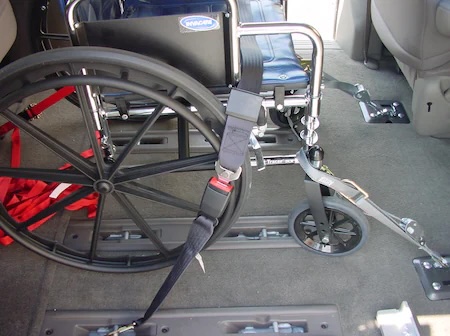
Manual wheelchair tie-down straps
Manual straps are the most common system you’ll find in a converted van. Four straps attach to the wheelchair at independent points, two in the front and two in the rear, and are anchored to the floor using an L-track bolted in during the conversion. The straps use a ratchet or cam buckle mechanism to tension and lock.
They’re straightforward, they work with virtually any wheelchair model regardless of age or brand, and they don’t require any modification to the wheelchair itself. Complete kits, including straps, lap and shoulder belts, and mounting hardware, are generally the most affordable of the three options.
The trade-off is convenience. Securing the chair requires someone to crouch down and manually attach each strap to the wheelchair anchor points. For elderly caregivers or anyone with limited mobility, that’s a real physical ask. The straps also stay on the floor when not in use, where they can collect dirt and get in the way when you’re moving the chair in and out.
Manual strap systems are a passenger-only solution. They’re not rated or designed for use in the driver’s seat. If the wheelchair user drives independently, see the section on docking systems below, and also take a look at hand controls and steering grips for the full picture of what a driver-configured van requires.
Pro tip: If you’re the primary person securing the chair, do a trial run before you buy the van. Have someone simulate the process in the vehicle you’re considering. Crouching and cranking a ratchet strap on a low floor track is harder than it sounds, especially if you’re doing it daily or if you have any back or knee issues. If that’s going to be a problem, retractable straps or a docking system may be a better fit, even if the upfront cost is higher.
Retractable Straps
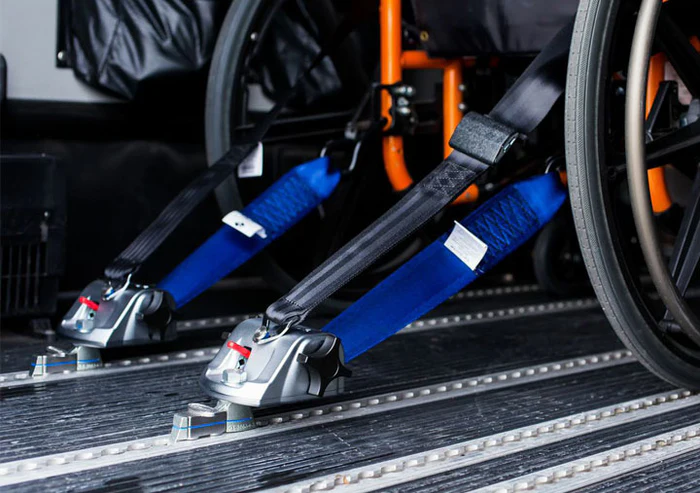
Q’Straint QRT retractable tie-downs
Retractable straps work on the same four-point principle but use a self-tensioning mechanism similar to a seatbelt. You connect each strap to the wheelchair’s securement points, and the retractable mechanism takes up the slack automatically. No cranking, no manual adjustment. When you’re done, the straps retract and stay out of the way.
They’re compatible with most wheelchairs, require no modifications to the chair, and don’t need changes to the vehicle beyond the L-track already installed. Complete kits with mounting hardware cost more than manual strap systems but remain a moderate investment compared to a docking system.
For wheelchair users who have enough arm strength to manage the connections themselves, retractable systems offer genuine independence as a passenger. They’re faster to connect and release than manual straps, and the retractable design keeps the floor clear when the system isn’t in use.
Like manual straps, retractable systems are for passenger use only. If you’re still figuring out whether your situation calls for a side-entry or rear-entry configuration, the side-entry vs. rear-entry guide covers how entry type affects passenger positioning and access.
Docking Systems (EZ-Lock/QLK)
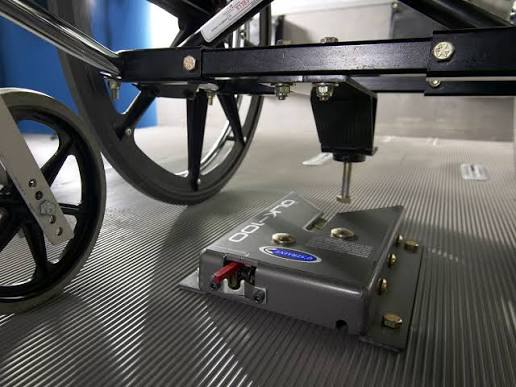
QLK docking system for wheelchair
Docking systems are the standard solution for wheelchair users who drive from their chair. Instead of four straps, a docking system uses a single base mounted to the vehicle floor and a bracket and pin attached to the bottom of the wheelchair. You drive the chair forward into the base, and it locks automatically. A green indicator light confirms a secure connection. To release, you press a button.
The system includes onboard electronics that monitor the lock status throughout the trip, with an audible alarm if the connection isn’t fully secure. Docking systems are crash-tested to WC18 standards and are the only wheelchair securement option approved for use in the driver’s seat position.
The two most widely used systems are EZ-Lock and QLK by Q’Straint. Both work on the same principle and use interchangeable brackets. QLK is the newer system and includes advanced features like remote-controlled unlock and Bluetooth connectivity.
For a wheelchair user who drives independently, there’s one more decision to make: will you transfer to the factory driver’s seat, or stay in your wheelchair to drive? If you can transfer, you get the comfort of the OEM seat and the docking system secures the chair while it’s unoccupied. If you drive from the chair, the docking system locks you into position at the driver’s location. Both are valid setups. Take a look at transfer seat options if you’re weighing that decision.
The trade-offs are real. Docking systems require authorized dealer installation and a compatible bracket mounted to the specific wheelchair. Not every wheelchair model is compatible, and the hardware cost is significantly higher than that of strap systems. The floor base is also a permanent modification to the vehicle.
If you’re considering a van that has a docking system already installed, confirm that your wheelchair is compatible before you commit. If it isn’t, you’re either adapting the chair or switching systems.
Pro tip: If the wheelchair user drives independently, a docking system is worth the investment. If they ride as a passenger and you or another family member handles the securement, retractable straps give you the best balance of cost and daily convenience. The question to answer first is always: who drives, and who secures the chair?
How the Three Systems Compare
| Feature | Manual Straps | Retractable Straps | Docking System (EZ-Lock/QLK) |
|---|---|---|---|
| Upfront cost | Low | Moderate | High (ask dealer for quote) |
| Requires assistant | Yes | No (with adequate arm strength) | No |
| Vehicle modification | None (L-track pre-installed in conversion) | None (L-track pre-installed in conversion) | Docking base required |
| Wheelchair modification | None | None | Bracket and pin required |
| Works in the driver’s seat | No | No | Yes |
| Universal wheelchair compatibility | Yes | Yes | No (check your model) |
| Professional installation required | No | No | Yes (authorized dealer) |
| WC18-compliant options available | Yes | Yes | Yes |
Not Sure Which Setup Is Right for Your Situation?
Call us and we’ll walk through the securement options and tell you what’s already installed in the vans we have in stock.
What’s Usually Installed When You Buy a Converted Van
Most converted minivans come with a strap-based system already in place. The L-track is installed as part of the conversion, and the van will typically include either manual or retractable straps. That’s the setup for the majority of buyers whose wheelchair user rides as a passenger.
Docking systems are less common as standard equipment and are usually an add-on. If a van in our inventory has a docking system installed, we’ll note it. If you want to add one to a van that doesn’t have it, that’s a conversation to have before you buy, because it requires authorized dealer installation and compatibility with your specific wheelchair.
If you’re evaluating a van and you’re not sure what securement system is installed or whether it’ll work with your chair, call us. We can walk you through what’s in the vehicle and what, if anything, would need to change for your setup. That’s exactly the kind of question we’d rather answer before you buy than after.
Common Questions
Does my van need a securement system if we only use it for short trips?
Yes. Distance doesn’t change the physics of a sudden stop. A hard brake at 35 mph produces more than enough force to launch an unsecured wheelchair. The system needs to be in use every trip, every time.
What’s the difference between the floor track and the straps?
The L-track is the anchor system bolted into the van floor during conversion. It’s the hardware the straps connect to. The straps are the securement device. Both need to be present and in good condition. The track is typically installed for life as part of the conversion; the straps can be replaced separately if they wear out.
Can I use any wheelchair straps, or do they need to match the vehicle?
It depends on which floor track system your van has. Side-entry vans most commonly use L-track, and most WC18-compliant strap kits are designed for it. Rear-entry vans often use Slide’N’Click, a different standard that requires compatible straps. Check which system is in your van before buying replacement straps, and when in doubt, ask your dealer to confirm.
How do I know if a docking system will work with my wheelchair?
Both EZ-Lock and QLK publish compatibility guides online. EZ-Lock’s is at ezlock.net/compatibility and QLK’s is at brackets.qstraint.com. You’ll need your wheelchair’s make, model, and frame type. Both systems work on the same principle and use interchangeable brackets, so if your chair is compatible with one, it will generally work with the other. Your dealer can also confirm compatibility when you’re evaluating a van.
Is EZ-Lock the only docking system option?
No. Q’Straint’s QLK system is the other major option and is currently the more widely sold of the two. Both are crash-tested to WC18 standards and work on the same docking principle. QLK adds features like remote-controlled unlock and Bluetooth connectivity. Either system is a solid choice. What matters most is that the bracket is compatible with your wheelchair and the installation is done by an authorized dealer.
We’re buying remotely — how do we confirm the securement setup before the van ships?
We do a live video walkthrough for every remote buyer. We’ll show you the securement system in detail, demonstrate how it works, and answer any questions about compatibility with your wheelchair before you put down a deposit. Read more about how the remote buying process works.
What if I have questions about the securement system in a specific van you’re selling?
Call or text us at (813) 212-9612. We can tell you exactly what’s installed in any van in our inventory, whether it’s compatible with your wheelchair, and what would be involved in upgrading or changing the setup.