
Before you look at a single van, there is one question worth answering first: how is the wheelchair user getting in?
Not the make, not the year, not the price. The entry configuration. Get this wrong and you end up with a van that does not work for your garage, your schedule, or the person using it. Get it right and everything else is much easier.
Here is how the two options compare, and how to figure out which one fits your situation.
Key Takeaways
- Side entry is the most common configuration and works for both drivers and passengers
- Rear entry works best for passengers and solves tight side-clearance situations
- The wheelchair user’s ability to transfer affects which setup makes sense
- Ramp type matters for daily use, especially if one person operates it alone
- Most buyers can land on the right choice with a single phone conversation
Side Entry Vans
Side entry vans load from the sliding door on the passenger side. The floor is lowered and a ramp deploys from the side, either automatically or manually, when the door opens.
This is the most common configuration on the market, and for most buyers it is the right one.
What makes side entry the go-to choice
The main advantage is flexibility. A side entry van can be set up for a wheelchair user who drives independently, a passenger who stays in their chair, or any combination. If the wheelchair user drives, a transfer seat option can be added so they can move from their chair to the driver’s seat. If they ride as a passenger, the chair locks into a designated position behind the driver.
Side entry vans also handle a wider range of chair sizes and weight capacities, and they tend to have more flexibility around interior layouts.
The one thing to plan for
Side entry vans need clearance beside the vehicle when the ramp is deployed. In a tight garage or a narrow parking space, this can be a real problem. Before you commit to a side entry van, measure your garage opening and think about where you park most often.
A good rule of thumb: you need about 3 feet of clear space on the passenger side for the ramp to deploy comfortably. Some power ramps need a little more.
Rear Entry Vans
Rear entry vans load from the back. The ramp deploys from the rear hatch, and the wheelchair user enters and exits from behind the vehicle.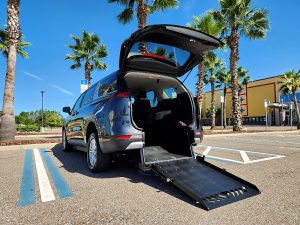
Rear entry setups are almost always used for passengers, not drivers. The wheelchair user rides secured in the rear cargo area, and there is no practical path to the driver’s seat without a transfer.
Where rear entry makes sense
Parking clearance. Rear entry vans need space behind the vehicle to deploy the ramp, but that is much easier to manage than side clearance in most situations. Standard parking spaces and most residential driveways work fine.
If you have a tight garage where the sliding door does not have room to deploy a ramp, a rear entry van may solve the problem entirely.
Rear entry vans also tend to be a little more compact in overall width, which can matter if the vehicle needs to fit in a narrow spot regularly.
What to know before you decide on rear entry
The wheelchair user will always ride as a passenger. That is not necessarily a problem, but it is something to confirm before you buy. If there is any chance the person using the van will want to drive independently down the road, rear entry closes off that option unless a transfer to the driver’s seat is practical for them.
Rear entry vans also use most of the cargo area for the wheelchair, so there is no trunk space when the chair is loaded. Everything else needs to come out of the vehicle first.
How to Decide: Three Questions Worth Answering First
Rather than thinking about entry type as a feature to choose, start with the person using the van. These three questions get most buyers to the right answer:
- Does the wheelchair user drive, or ride as a passenger? If they drive independently, side entry with the right floor plan and a transfer seat is almost certainly the right direction. If they always ride as a passenger, both options can work.
- What does your parking situation look like? Tight garage with limited side clearance points toward rear entry. Open driveway or garage with room on both sides gives you more flexibility.
- Does the wheelchair user transfer out of their chair, or do they ride in it? If they stay in the chair, pay close attention to chair dimensions and the interior width of the van. If they transfer, a transfer seat option opens up more configurations.
A Note on Ramp Types
Both entry configurations come with different ramp options. Power ramps deploy automatically at the push of a button. Manual ramps fold out by hand. In-floor ramps stow flat and keep the interior more open when not in use. Fold-out ramps attach to the doorframe.
The ramp type matters for day-to-day use, especially if the primary caregiver is operating it alone. Worth discussing when you look at specific vans.
What We Carry
We keep side entry and rear entry vans in stock at any time across multiple makes, including Toyota Sienna, Chrysler Pacifica, Honda Odyssey, and Dodge Grand Caravan. Inventory rotates, so the best way to see what is available right now is to browse the lot or give us a call at 813-212-9612.
Most of our vans carry a rebuilt title. If you have not looked into what that means yet, the short version is that it is not the same as a salvage title, and it is worth understanding before you make a decision either way. The full explanation is at our rebuilt title page.
Buying Without Seeing the Van in Person
Most of our buyers purchase remotely. If you are trying to figure out which entry configuration works for your situation without being able to visit in person, that is something we walk through on a call. We do live video walkthroughs of the van so you can see exactly how the ramp deploys and how the interior is set up before you commit to anything.
You can read more about how that process works at our remote buying guide.
Common Questions
Can a wheelchair user drive a rear entry van?
Not from the wheelchair. Rear entry vans are configured for passengers. If the wheelchair user wants to drive, side entry with the appropriate floor plan and a transfer seat setup is the right direction.
What is a transfer seat and do I need one?
A transfer seat is a swivel or removable driver’s seat that makes it easier for someone to move from a wheelchair into the driver’s position. Not everyone needs one, but for wheelchair users who drive independently, it is often part of the setup. See our transfer seat page for more detail.
How much clearance does a side entry van need?
Plan for at least 3 feet of clear space on the passenger side. Power ramps on some models need a little more. If you are not sure whether your garage will work, measure the width from the passenger side of the vehicle to the nearest wall or obstruction.
Are rear entry vans harder to insure?
No. Entry configuration does not affect insurability. Rebuilt title does have some nuances worth knowing, which we cover on our rebuilt title page.
What if I am not sure which one is right?
Call us and describe the situation. Who uses the van, where it parks, whether they drive or ride. We have walked a lot of buyers through this and can usually point you toward the right configuration in a single conversation. You can also contact us here.